In Honor of the Life of Friend and (like) Sister, Kate Leighton

Every Sunday at church we recite the creed from Iona Abbey. It’s not a standard or traditional Episcopal way to affirm faith, but it is a deeply theological and spiritual mode of such expression: broadening the language to make the concepts embedded therein accessible to a wider audience, specifically those traumatized by fundamentalists, literalists, and dogmaticians hellbent on one way (their way) or the highway. But it’s not only the broadened language that is its unique contribution to creedal expression, it’s the way the words themselves—though very simple—participate in the descriptive imagery daring to paint divine imagery of the three persons of our Christian Holy Trinity. Of God the Creator, ethereal and light words lift the confessors, bringing them into celestial realms, the feeling of the cosmos fresh on skin, eyes filled with heavenly light, ears ringing with angelic symphony as one finds themselves embraced and enveloped by “God Above us.” Of God the Redeemer, the same confessor is brought down to earth by words incarnate made of human existence presencing the suddenness of the onset of child-bearing labor: “God Beside Us” born among us and dwelling in earthy existence, flesh and bone, vulnerable and exposed, subject to the pain of life and death. This one is with us; this one identifies with us.

But when the creed comes to speak of the third person of the Trinity, the Divine Holy Spirit Comforter and Paraclete, the words take on a separate life from the ones that fell before. The ethereal and abstract words describing God Above Us and the material, temporal words describing God Beside Us give way to words that solicit rapid heartbeats and joy that surges through the bodies of the confessors. The words begin to dance, and the confessor is their partner, twirling and whirling lovingly captured in lexical perichoresis:

“We believe in God within us,
the Holy Spirit
burning with  Pentecostal fire,
life-giving breath of the Church,
Spirit of healing and forgiveness,
source of resurrection and of eternal life.”

In the context of the thanksgiving worship of the eucharist communion service, this change makes sense spiritually as well as theologically. It is through the Spirit we are, by faith in Christ, anchored into Abba God. It is through the Spirit that our very breath as beings and as beings in Christ finds foundation. The church (both general and particular) must acknowledge that its birth certificate resides with the Spirit in the event of the intimate divine encounter of Pentecost; it is this same Spirit that will keep continuity within Christ’s body from one era to another, grafting in those who go before and those who come after. By the Spirit, we are yoked to a God who is Love, Who is Light, Who is Life, and Who is liberation (even when things feel cold and dark, when chaos and confusion seem to be our only cairns on the path, even when anger, grief, and sorrow alight upon our fragile, vulnerable existence). By the Spirit, God Above Us and God Beside Us not only become real to us but are made real in us. It is the Spirit by which one can’t help but feel that all that is isn’t all there is. Hope rises; possibility has priority over actuality; good news comes.

But the point of bringing this up is neither to wane uneloquently about this humble creed of Iona Abbey nor to invigorate in my reader a robust role for the Divine Spirit of Abba God. I mention this portion because it is this very portion that is to me a great announcement of Kate’s life and impact on the world around her and the people so fortunate to be touched (and forever altered) by her. To encounter Kate was to be encountered by the divine spirit, the pathos and zeal of God for the Beloved like the prophets of old, those who felt (deeply and personally) the pain and love of both Abba God and humanity, daring to be a conduit and midwife of love for both. To encounter Kate was to be exposed and accepted like the encounter with the incarnate Word who set about to liberate and bring life to human beings stuck in captivity and the threat of death. To encounter Kate was to be invited to dance with her; caught up and twirled and whirled about by both her wit and intelligence while being guided by her gentle hand and deft step, so consumed with the ease and seeming simplicity of the motions, one would cease to remember who was leading whom.

If there ever was an embodiment of “Holy Spirit burning with Pentecostal Fire” it’s Kate. Her passion and energy for those she loved and the world around her wasn’t only palpable but infectious. She bore into the world joy, celebration, and enough holy mischief to rattle the status-quo. She identified with others and was connected to the world, even if it meant bearing the pain around her in her own person. In word and deed, she gave life to those around her: her presence marked a boundary in space and time that was for them, to be who they are as they are without needing to don a façade behind which to hide to be “acceptable” and remain safe. Thus, she liberated those whom she met, liberating them unto life by her authentic love for them. Whether inside the medical institution or outside, she healed others (spiritually and materially); and she lived a life continually expressing the profundity of divine forgiveness transcending mere human words finding location in the temporal realm. In all of this, Kate participated in making a reality today tomorrow’s hope of resurrection and eternal life announced to us by Abba God, made real in Christ, and sealed to us through the Holy Spirit.

While I find hope in reuniting with her in God at some point in my future, her physical absence is felt deeply. I must now wait to see her again. But in this waiting, I am encouraged and exhorted by God’s Holy Spirit to carry forward the light she brought, the life she gave, the liberation she offered to others. In this way, I carry her and her life’s work further into the world. In picking up her mantel, she is remembered and loved. In being remembered and loved, she is present. Since Love never forgets the Beloved, there the Beloved always is, beside us and with us.

I miss you Kate, and I love you deeply.

What is Truth?

The following is the opening portion of a Christmas letter I wrote at the end of 2024. I’ve been meaning to post it, but haven’t gotten around to it…until now. So, here are some random musings from yours truly. If they hit and serve you; I’m glad. If not, leave them behind; I would never want you to be burdened by my own “stuff”.

Christmas 2024                                        

“Therefore, Pilate said to him, ‘So then, you are a king?’ Jesus answered, ‘You, you say that I am a king. For this I, I have been born and for this I have come into the cosmos, so that I may witness to the truth; everyone who is of the truth hears my voice.’ Pilot said to him, ‘What is truth?’” (Jn. 18:37-38)

Truth seems a tricky beast to get a hold of, like grasping at oil or sand. There’s a brief moment when I feel like I’ve got it in hand and then…what I thought was mine is now no longer mine as it spills out from a fist clenched with desperation. I’ve always considered our human travels through time on this rock as the way we accumulate more truth (like coins in a jar). But, looking around here at the end of 2024, I’m not so sure that’s the case. I feel no closer to the truth today than I did in January. Sadly, I feel further from it this year than years before. It seems our information landscape is a veritable wasteland of dis- and misinformation; a minefield to navigate with alertness and wakefulness that only ends up producing existential fatigue. I have no choice but to echo Pilate with weak lips, What is truth?

I have a hard time asking this question aloud because it’s often met with scientific, intellectual, philosophical, theological, and party-political pat responses. But truth isn’t fact strictly, and it certainly isn’t dogma or human-made ideology. These are all things drawn from the truth because human beings are eager to make sense of their environments and place in history. Facts and ideologies are material manifestations of the truth that (eventually) become captive to space, decay with time, and will (if we allow them to) die. But truth can’t be confused for these things no matter how comforting that may be; truth refuses capture and denies us the ability to mount it on our wall like a trophy.

If I’ve learned anything this year, it’s that truth isn’t a thing; it’s a summons, a disruption, it’s what liberates us from the captivity of what was. It’s the thing that gets us to turn our heads towards the future while standing in the present and remembering what was rather than clinging to it; truth beckons us to let go of what we have known and receive something new. So, this is why I dragged Easter into Christmas. Advent is our time of waiting for the arrival of God in our moment; our eager expectation to be flat-out and totally ruptured from what was and is (the status quo). God promises to show up and bring God’s reign; in the nativity of Jesus Christ God does show up. The birth of Christ is a great and heavenly fracture of geological time and space. But it’s the beginning; the story doesn’t stop there. Behind the manger looms the cross, and it’s in the cross and resurrection event (whether you believe them to be fact and real or not) where the world will never truly be able to go about its business as if something didn’t just happen, as if the earth didn’t just shake, as if the illuminating light of God didn’t stream forth and expose all those who witness it (literally or spiritually, historically and currently).

The birth of Christ is not a light that only shines backward illuminating the past (woe to me a sinner); rather, it’s a beacon that shines forward, illuminating our path forward (surely this man is God). Herein lies truth. Jesus says that he came into the world to witness to the truth of God; this means nothing less than to witness to God’s reign and mission of love, life, and liberation in the world. Wherever there is indifference, the truth will beckon us to bring God’s love; wherever there is death, the truth will beckon us to bring God’s life; wherever there is captivity, the truth will call us to fight for divine liberation of God’s beloved. According to Jesus at the penultimate Good Friday moment, truth is a voice calling out, summoning me to drop my nets and follow God not backward toward what is familiar and known, but to be ruptured from what was, to go forward, follow Christ and step into the unknown. Dorothee Sölle (German Lutheran Liberation Theologian)writes,

“Christ’s truth is concrete.…By concrete we mean changeable according to the situation and according to human needs; able itself to change a situation and liberate from oppression. This kind of truth must be realized and so it can be experienced but it cannot be known in advance. It can be made but not determined.”[1]

The divine summons of Advent is into this truth of the reign of God defined by love, life, and liberation.


[1] Soelle, Truth is Concrete, 7-8.

A (little) Lesson from History

The following paragraph is from Joachim C. Fest’s Hitler (1974) (bibliographic information down below) and is from the very end of the text, “The Dead End.” While Fest is talking about 19th/early 20th century German, the conclusions he draws from the story of Hitler’s political life with the people are conclusions that expose some of the current trends in our own moment here in America. It’s these exposures, these moments when reading about another’s history and we see ourselves trodding down a similar path, that are important to take heed of, to listen to, to walk through the discomfort of… Just as people were just people in early 20th Century Germany, so are we just people–no more resistant than they to authoritarianism, nationalism, and (even) fascism. We are not a different breed of human, and especially not if we choose to ignore where and when history can and might repeat itself. So, I offer this paragraph as a moment for consideration of our own time, our own location in history, and our own relationship to this American political endeavor of democracy. In the end, we must be aware of our tendency to want to do away with “politics”, to be done with it, to hand it over to someone else so we don’t have to “worry” or “think” about it anymore. We must take seriously not only the rhetoric around but the ease of our tendencies toward private, autonomy, and the malformed conception of freedom as “freedom from the neighbor for myself.” We might be exhausted from party-politics and the constant manipulation of our fear and anger, but we must not confuse this exhaustion for an exhaustion with the entire idea of politics, which is larger and broader and deeper than simple party politics; it is the very ground under our feet as we move through our societies with each other. Enough from me, here’s Fest:

The National Socialist revolution did not merely shatter outmoded social structures. its psychological effects wen very deep, and possibly this was in fact its most significant aspect. For it totally transformed the entire relationship of Germans to politics. On many pages of this book we have mentioned the extent to which Germans were alienated from politics and oriented toward private concerns, virtues, and goals; Hitler’s success was partly due to that state of affairs. For on the whole the people, restricted to marching, raising hands, or applauding, felt that Hitler had not so much excluded them from politics as liberated them from politics. The whole catalogue of values, such as Third Reich, people’s community, leader principle, destiny, or greatness, enjoyed such widespread approval in part because it stood for a renunciation of politics, a farewell to the world of parties and parliaments, of subterfuges and compromises. Hitler’s tendency to think heroically rather than politically, tragically rather than socially, to put overwhelming mythical surrogates in place of the general welfare, was spontaneously accepted and understood by the Germans. Adorno said of Richard Wagner that he made music for the unmusical. We might add, and Hitler politics for the unpolitical.

Joachim C. Fest, Hitler, translated by, Richard and Clara Winston (New York: Harcourt Brace Jovanovich, 1974), 792. Originally published as Hitler, Berlin: Verlag Ullstein, 1973.

“A Hopeless Undertaking”

The following is a quote from Dorothee Sölle’s The Truth is Concrete (1969). It’s from the eleventh (and last) chapter, “Church outside the Church.” I bring this quote to light because it highlights Sölle’s prophetic witness and her keen insight. What she says here, I believe, applies to the C/church today. In 2024, we are in no better spot when it comes to desperate attempts to validate the C/church’s presence in the world. And the worst part, which I find well articulated here in Sölle’s words, is that the church prefers recourse to archaic structures and systems and useless assertions of power and demand, conformance and performance that seem to deny our technological and scientific advancements OR pretend that the human person is all fact and data, pure material truth without need of a reinvigoration of the retelling of our sacred myths (the enlightened and intellectual denominations (so proud) often jettison the very awkward message of the Christian sacred text and, thus, relinquish full interpretive control to the fundamentalist, rightist wing). Anyway, here are some words written about 55 years ago; enjoy and find within a summons to reconsider “Concrete Truth”:

“The main points in the structure are boundaries, danger, fear. The great enemy, the devil in ever new shape, is the world. The Church is always ready to forget that Christ has got the power over the dominions and that his victory is not just personal salvation of the individual but he has also changed the face of the world. We may remark in the last two hundred years that the situation of the Church has become more and more complicated, with the progress of secularization. She can no longer rely on the ancient pre-scientific fear-bound imaginations. She is losing her authority, her dominant position, she has become one power among many, and must therefore defend herself! She defends herself externally by virtue of claims to power which bear more or less weight according to the political situation. Internally she deals with her loss of authority by trying to preserve an outdated social structure. She proclaims that a part of the world, the past world, is unassailable and not subject to historical change. Then she bullies people to perform certain tasks which are made into conditions of membership of the Christian community. Somewhat unwillingly, she builds her walls and demands a way of life whose style and social norms and image are necessarily bourgeois. She demands, which is worse, the sort of community adherence which can no longer be expected, since people have less and less desire for this kind of thing. She demands, finally, that people should be interested in an ancient document, the Bible. These demands clearly constitute high walls. They are attempts to arrest the progress of secularization, at least in this area. It is a hopeless undertaking.”

p. 102-103

Courage to Retrieve the Beloved

The following is the text of my short offering during a service last night (1/14/23) in honor of Martin Luther King Jr. at American Lutheran Church, Grand Junction:

It was a beautiful Mother’s Day. We gathered the kids, an aunt and uncle, and headed out to celebrate the day. Our destination was Miracle Rock (aka Potato Rock). We reached the stunning geography, admired the rock, and decided to mill about, and let the toddler down from her hiking-backpack. For what 18-month-olds lack in fine motor skill they make up in large motor function; my daughter could run. And she did. She was! In moments, a blink of an eye, with no warning, she bolted out of reach before we knew what was happening. Her new-found freedom provoked her confidence and, to her, the entire world spread out and needed to be suddenly investigated. But what she couldn’t see, her parents did: the edge. We called her. She didn’t stop. We started to run after her but she was too far ahead of us; we wouldn’t make it in time. Plus, wouldn’t chasing her become a game? No way to catch her as the deadly horizon drew closer. Desperation kicked in; reality fell like a heavy blanket. Out of options! With what felt like seconds left to change her trajectory, to interrupt her path, I waved off my husband and did the only thing I could do in that moment. I gathered up every ounce of strength I had, and I hollered: “LIZA! STOP!” so loud every muscle flexed, and I sent myself backward. But she stopped. Mom-voice hopped up on the steroids of love and life, she stopped. Mid stride, feet from the edge, she collapsed into a ball on the ground and wept. My husband was closer than I was and able to retrieve our weeping mass of baby; she was safe.

Love sounds her maternal yawp against looming destruction, life fights back the tentacles of death.

There’s a confession embedded in the theme of today’s service; the exhortation to develop courage means we must reckon with the fact that if we had courage we lost it. Where did our courage go? Maybe its buried under lethargy; everything feels so exhausting right now. Maybe our courage is gagged by forgetfulness; we move on faster and faster from traumatic events (because terror is becoming normal). Maybe our courage is trapped under fear; there’s no assurance and security right now (sending three kids off to school 5 days a week, my one prayer is please bring them home to me tonight). Maybe our courage is confused; disoriented behind weaponized walls of cis-het whiteness, patriarchy, and Christian nationalism. Or maybe our courage has atrophied; malnourished by lacking creative and curious activity, starving for hope and mercy. Whatever the reason, we must confess we do not have more courage than we did nearly three years ago and whatever we had then is now gone. The world is not better, it is not safer, it is not more alive.

Love sounds her maternal yawp against looming destruction, life fights back the tentacles of death.

While we stand in a very vulnerable place, aware of our lack, there is good news. It’s here, in the fleshiness of our confession where we’re beckoned by love’s voice into the arms of life out of the threat of destruction and out of the grip of death. These two need be our despotic rulers no more; because here in this meeting in the vulnerability of confession, clutched by love and life we are reconciled with our courage to resist their tyranny. Courage is not mustered up from the isolation of ourselves by ourselves, it cannot come to the surface if we continue to turn more and more in on ourselves by ourselves. Rather, it is born (again) in our triune comingling with life and love; because, in our individual confessions we see and hear that we are not alone, we stand in and with a great crowd of other witnesses. Consumed by the divine spirit of life and love we are invited to start again not alone but together. We are exhorted to take hold of our courage again, together. Here, with each other, we begin again, we begin anew. Here, with each other, we are emboldened to stand up however we can, reanimated with verve and vigor. Here, together(!) we are resurrected out of lethargy, out of fear, out of forgetfulness, into love’s land of daring curiosity and life’s audacious creativity; repowered to dream dreams, to have visions of possible impossibilities, to imagine the creation of better worlds marked by liberation and justice for all. Here we find what was lost: ourselves, each other, and our voices. And if we find these, we find courage abundant because we are a force to be reckoned with together.

The Rev. Dr. Martin Luther King, Jr, in his Sermon “Paul’s Letter to American Christians,” said,

“The greatest of all virtues is love.…In a world depending on force, coercive tyranny, and bloody violence, [we] are challenged to follow the way of love. [We] will then discover that unarmed love is the most powerful force in all the world.”[1]

Here, together, in the word of love and life we are given the potent and visceral force and strength (the courage!) to sound our maternal yawp against looming destruction, to actively join in life’s fight against the tentacles of death to retrieve the beloved (our siblings and ourselves) from the tentacles of death.


[1] The Rev. Dr. Martin Luther King, Jr. “Paul’s Letter to American Christians” Strength to Love Minneapolis, MN: Fortress, 2010. 153.

Grateful Ungratefulness

The following segment, running about 5 minutes, is from an event I had the honor of participating in with an organization I’m a member of on behalf of the church I run. The Grand Valley Interfaith Network celebrates THANKSGVIN during the week of Thanksgiving and incorporates a variety of the sacred traditions within the Grand Valley area. Each year there’s a different theme, and all participants are asked to speak (briefly) on that theme from their tradition’s perspective. This year the theme was “Gratitude”, and was hosted by American Lutheran Church pastored by the Rev Valerie Carlson (she’s awesome!). My segment starts at about 55:00, and hopefully I’ve queued it up here (below) correctly. The text is below the video.

I’m ungrateful.

The sun rises and the sun sets; hate still tramples about stealing life from beloved bodies. Joy and rapture cut short while love and acceptance is silenced by violence. Their happiness, their liberty to be, their life unacceptable to those who believe such things are reserved only for the elite, the powerful, the white, the heteronormative, the conforming, those who worship at the altar of Moloch drinking lustfully from terror’s cup, bending the knee to weaponized malevolence, consumed by the venom of malice. This world is colder and dimmer because Daniel Aston, Kelly Loving, Ashley Paugh, Derrick Rump, and Raymond Green Vance no longer participate in this material life, no longer darken doorways of their family and friends, no longer take up beautiful space.

I’m ungrateful.

We are sick; we have an illness. We pretend it’s not wreaking havoc on every cell of our body. We go from one horrific incident to another as if this is all normal. Humans killing humans isn’t normal. Stock piling militarized weapons isn’t normal. Our silence is acceptance of conditions not oriented toward life, isn’t that abnormal? Think about it. Where is our desire to live? Where is our verve for liberation? Where is our fight against death? Why are we rolling over, pulling the covers over our head, and waiting for the next incident to flicker onto and illuminate our screens? When do we stand up in this boat being rocked by the appetite of voracious and rancorous waves and winds and sound our maternal yawp protecting our own? How many more lives must be lost before we holler our divine spirit’s “No!”? How many children, brothers, sisters, moms and dads, lovers and friends, must be violently and suddenly yanked way before we tell those damned waves and winds to shut up and sit down? How long? How many more? Do we not care?

I’m ungrateful.

I’m a pastor; I’m called to serve life not death. I’m a child-bearer; I’m called to push forth life not death. I’m a teacher; I’m called to cause space and place for life to thrive and not death. I’m an ethicist; I’m called to advocate for life over death. I’m a human; I’m called to share and participate in life with others in retaliation against death. So, I’m ungrateful because this society repeatedly chooses death over life, and I’m not okay with it because it goes against who I am and my calling, it rails against a God of life and love, and puts those whom I love—those whom I’m charged to love by God—in grave threat and danger. But then, as I linger here in my ungratefulness, my anger, my frustration, my solidarity with those whom I love I realize: they are worth fighting for. You are worth fighting for, life and love are worth fighting for. And, for that I am very, very, very grateful.

Weekly Update (7/17-7/23)

So sometimes I follow through with plan. Here I am with an update that is actually weekly. Go me. Though type of post is morphing into what is a reflection on my thoughts for the past week than necessarily an update on my tasks (which are rather monotonous and boring).

The paradox of human life, the complexity of being human hits home when I think to myself: yes, a win for me. And then, turn around and contemplate all the death and failure littering my landscape. If anything is being driven home to me over the past couple of years (what day of March 2020 is it?) it’s the necessity of finding stability in the midst of uncertainty, and that finding said stability can happen. I’ve joked in the past that me running a church is like a local parish version of Indiana Jones and The Temple of Doom. Every step is uncertain and the only certain steps are the ones I’ve taken (both successfully and unsuccessfully). But this type of uncertain stepping is growing familiar, so is stumbling when that step gives way and the thrill of security of stone beneath my feet.

Everything begins to be redefined when you walk like this, nearly in place but making strides forward nonetheless (sometimes, it’s good to turn around and see just how much progress you’ve made, it’s more than you realize). For me, contemplating concepts like hope and faith, love and grace, fear and anger, take on different complexities today than they did three years ago. All that we have is now and it is what it is are my go to phrases and mantras. New foci come to the surface in these times, walking with such intention and being forced to be so present where you are. For me, someone so oriented on tasks and deeds (read: books and writing) I’ve become more and more aware–in a visceral way–how important people are. I don’t think it helps that I’m waist deep in Dorothee Sölle’s work, a true theologian of the people for the people. (More on her another time, if it’s so desired.) But seriously, people matter. YOU matter.

So, as begin to see how much people matter everything around me becomes about people: does this thing cause people to thrive or does it hinder them? If it hinders their thriving (and especially if it hinders their survival) do we need to eliminate it, redefine it, rebuild it? These questions are important, and we have to ask them because people are dying. And none of us should be okay with that. So, how do institutions like the church and the academy (two institutions I love and serve (in some form)) participate in the people’s thriving or death? If as a priest and academic my works do not bring life and liberation to people, then I must reevaluate and ask why? I must look at the rituals and rites, the demands and expectations, the traditions and tasks, the building and the presence, of both and at how I participate in each realm in perpetuating death and violence and life and liberation.

I must ask hard questions here:

What is the Academy? What is the Academy for? For whom does the Academy exist? What does it mean to be a scholar? What does it mean to be a professor? What is a scholar? What is a professor? What is my focus here? Is it me and my scholarship? Or is it those whom I’m charge to teach and educate? Where is the institution causing unnecessary burnout through too much bureaucracy and administration?

What is the Church? Who is the church? What does it mean to be a priest? A deacon? A Bishop? Are all these rites and rituals necessary? Where do they bring comfort? Where are they bringing death? What does power look like here? Should we even have “power” held by humans in the church? Where has our hierarchy gone haywire? Where are we serving our own spiritual wantonness as leaders of the church rather than the beloved of God? Why are roles being abused? Why has the church been so willing to lose it’s story? (Here I can only ask this of the Episcopal Church, of which I’m an ordained priest.) What do we even believe? Why exist as the c/Church?

What traditionalisms must be put to final rest? What deeds bring the most life? Where is fear running rampant? Why is fear even present here? Where did we lose our way? Where have we (as leaders) gone wrong and astray? Where is our humility? Where is our confession? Where is our self-awareness? Where are we placing unethical financial demands on people? Why are we doing this? Why are we demanding archaic adherence to activities and deeds that worked before Covid happened but no longer work? And, did they ever work before Covid? Where are we still serving patriarchy, abelism, capitalism, selfishism, autonomy, heteronormativity, sexism and racism? Why are we still serving these things? Why and where are we, the leadership of these institutions, further burdening really burdened people?

Where are we stuck? Where are we growing? Are we growing? How do we become unstuck? To what desires must I die? Where am I putting myself too much ahead of others for no good reason? Where do I need to relearn? What do I need to relearn? What do I need to unlearn? Where am I forcing people into my own ideologies and ideas rather than allowing them to self-express and self-determine and self-realize?

Anyway, there are so many more questions we can be asking right now as we walk through this moment in history. My heart breaks as I watch two institutions struggle to maintain what was rather than embracing the transition through death into new life. I know we need something new in both arenas; I don’t know what that looks like. I do think that if reformation doesn’t come to both, they will continue to hinder life and liberation more and more and the bodies will continue to stack up. We cannot continue for too much longer with the way things are. I’m finding it harder and harder to uphold and honor commitments to both when I see people being more and more wounded and sacrificed on the altar of Mammon.

For the love of God, in the name of Christ, by the power of the Holy Spirit, people matter, God’s beloved matters, YOU matter. And for you, I’ll fight.

Weekly (not so weekly) Update

It’s been a bit.

I wish I could tell you I’ve been out traveling with my family or taking fun vacations; I wish I could tell you that I’ve been enthralled with scholarship, joyfully trapped by the plot of a book, or wrapped up in new ministries. None of these things kept me away. Truthfully…

It’s been a bit much.

Everything is heavy, right now. Without having to share details, people are dying, institutions are dying, relationships are dying, and most days I just need to focus on getting to the end of the day as present and accomplished as I can be. And by “accomplished” I don’t mean “successful” in the way it’s used in our rather competitive, dog-eat-dog world. I mean: I got done what needed to get done … and no one was mortally wounded in the process. I can’t even imagine trying to “win” right now…

It’s all too much.

I think what really weighs heavy on my mind and soul and body is that I know I’m not alone. I think we are all struggling. I think that’s why many forms of social media became too much for me. We’re digitally recreating mythical worlds that look sparkly and shiny and serendipitous, but yet we’re all struggling. We’re trying to cast illusions like magic tricks in the attempt to tell ourselves: everything is fine, this is fine. Many of us are (rightly) afraid, and being afraid breeds anger, and anger breeds exclusion, and exclusion breeds isolation, and well isolation breeds…

…too much.

It’s weird redefining what it means to be “successful.” Just arriving at the end of each day and watching those days accumulate in the succession of weeks tells me I’ve succeeded–everything is still running, even if just barely. Success means keeping my daily routine in check and seeing how it brings comfort to my kids. Success is waking up once again and saying, yes, I think I can do this again today…I think I can carry this heaviness, this sadness, this discouragement one more day. Sometimes I shudder thinking what will happen once I move through this difficult phase of existence into an easier one (no, I’m not talking about death into new life, but just literally a letting up of heavy). I fear it will be a lot…like, maybe I’ll break down, and people will say to me,

that’s a bit much, Lauren.

What’s most interesting to me is that while things feel heavy, I still feel my hope and the ever present sense that possibility is just right next to me. I know it mars my academic cred to confess this but… I’m a theologian of hope, through and through and through. I see no reason not to have it; I do see every reason to rescue the concept of home from it’s abusive partner: future expectation. My hope is embedded in that which I cannot see–the possible. And I hold this hope not according to time (or, our human conception of time in its linear mode) but space and that which is just beyond the material I can touch–the things of now but yet unseen, unfelt, unexperienced, untasted. I look around and I can see a lot, but that which I cannot see is

much, much more.

I planted my garden this year and had seeds designated in specific spots. I had no idea there was also growing at that moment mammoth sunflowerS and compost carrots:

I mean…that’s a lot of Mammoth Sunflowers and Carrots and the wall of Parsnip flowers hiding below the surface…

That’s almost too much!

So, I can’t just ever think that this is all there is because there’s always so much more than this going on at this moment. Just because we can’t see it doesn’t mean it isn’t. That’s a lie of the worst kind and it takes massive amounts of hubris to believe that the universe is restricted to what *we* can see and touch and feel and think and comprehend and discern… I mean, really, think about it. Where do we get off thinking in such finite ways and then casting those assumptions vast and wide as a new form of inerrant scripture with our tiny human brain parading about as God. I’m not trying to make an apology for God, but I do think we might owe the universe a massive apology.

We’re too much.

Anyway. Hang in there. Take my hand. Let’s walk this heavy together. The more we share the burden the less that burden is…

too much.

Another Year

I chuckle when I get reminders like this.

But maybe this year I need the reminder. Not the one telling me it’s my birthday, but the imperative: enjoy this special day.

I’m a big fan of birthdays. I love them; more than I love Easter and Christmas. Birthdays mark special moments where someone became something out of nothing. What wasn’t now is, type stuff. Existence doesn’t really make a lot of sense to me. Not existing makes sense, but being born and living as we do in ourselves as we are, in all of our uniqueness and oddness and packed full with idiosyncrasies? Think about it. It doesn’t make sense. Existence is really incredible; the impossible made possible.

But lately existence feels hard, heavy, like wading through molasses. Enjoying a day that marks the anniversary of your non-existence turned existence, feels existentially cacophonous right now.

But maybe that’s part of the point of existing out of non-existence: the perpetual threat of not existing highlights the marvel that is existence. And maybe there in I can locate my enjoyment of the day: dare to celebrate in the face of reasons to give in to the gentle downward pull of the existential molasses I find myself caught. To enjoy even now, to celebrate even now cuts through the fabric of suffering with the revolution of life and love.

In this I am reminded (and encouraged) by some words from The Rev. Ada Maria Isasi-Diaz,

La lucha and not suffering is central to Hispanic women’s self-understanding. I have gotten the best clues for understating how Latina understand and deal with suffering by looking at Latinas’ capacity to celebrate, at our ability to organize a fiesta in the midst of the most difficult circumstances and in spite of deep pain. The fiestas are, of course, not celebrations of suffering but the struggle against suffering. The fiestas are, very often, a way of encouraging each other not to let the difficulties that are part of Hispanic women’s daily life overcome us. They are opportunities to distance ourselves from the rough and arduous reality of everyday life, at times mere escapism, but often a way of getting different perspective on how to carry on la lucha. Listening to the conversations that go on at the fiestas and participating in them makes this evident. What one hears is talk about the harshness of life. Of course at times it is a mattery of simply complaining. But often it is a matter of sharing with others in order to convince oneself of what one knows: that one is not alone; that what each Hispanic woman is going through is not necessarily, or at least mainly, her fault but is due to oppressive structure…Fiestas are a very important way for Latinas of not allowing only the suffering in our lives to determine how we perceive life, how we know, how we understand and deal with reality.

Mujerista Theology p. 130

So, let’s have cake and dare to celebrate.

Week in Review (6/5-6/11)

Another week, another moment to self-reflect internally and externally.

I made mention to my partner last Saturday that writing up the post covering the previous two weeks felt like “old-school” blogging. I didn’t care about the flow, really; I didn’t care what any one was going to say. I just wrote. As a writer–I’ve been one since I was 5–it was a liberating experience because I spend my writing time now writing for other people and attempting to preemptively figure out where the weaknesses are in my thoughts so to receive the least amount of criticism. All of my writing currently is literally up for review in some kind: sermons, poems, prose, dissertation, book reviews, etc. And while I know the value of that type of writing (and by the way, if you didn’t know, all of those genres I just listed all have different grammatical and syntactical and logical demands), I think (maybe?) I need more moments of just writing as if no one was looking, or…rather, more moments where I’m writing as if I don’t care about who sees what…I think that help builds confidence in the end…

Do you remember just getting on the blog and word dumping? Maybe some of you remember MySpace. I didn’t really use it. Do you remember the time before the time you felt compelled to build a brand or a platform? When you knew only your friends were reading and so why bother with everything being perfect as if you were submitting a journal article for peer review? Where you just wrote and let that stream of thought weave and wend, bend and twist, curl and furl where ever and whenever it wanted?

I miss that effervescence (a word I nearly spelled correctly on the first try!). Everything has become about production of a product that is unique, but what’s most fascinating about that pursuit is… It all becomes the same. I think being yoked into one brand or one platform (I’m this person, I’m this message) renders one into an intellectual division of labor that is destructive and violent to the inner world of the writer. I think it limits growth. While writers should always be about changing some part of the world in some way with our words, I don’t think we must then brand that, nail it down, and let that box suffocate us. If there’s any “platform” I want it’s one disoriented toward production and oriented toward people, a platform upon which I stand and holler…things practical, or things insightful, or things interesting, or things just flat out odd, or things that are still in process and as soon as they come out I think…oh, wait, I need to rethink that

Not all writing can be written and released into the world in such a fashion (I’m aware, see above), but maybe some of it should be so we writers don’t forget how much this art brings us life, so that when we return to our academic or creative projects, we have something more (better?) to give them rather than a hope and a prayer that we’ve upheld our platforms and brand. When it’s all said and done, and we go the way of dust and dirt, that which we’ve left behind does not and will not carry our platform and brand, it will have it’s own message which will change in each era it’s encountered, held by hands different and distant from ours, read by eyes and ears and fingers asking questions greatly altered from ours, internally digested and externally practiced in environments, societies, cultures, atmospheres, (worlds? galaxies?), moving in trajectories and operating in and out of boundaries we can’t even imagine.

Let us write with intention and substance, but may that intention and substance be not for our glory and fame, but for the good of the world.

With that said, here are some fun things from my week:

  1. I promised some images of the gardens (herb and regular). Here is the fulfillment of that promise:
Vegetable Garden with a few Mammoth Sunflowers planted I by either the wind or a bird!
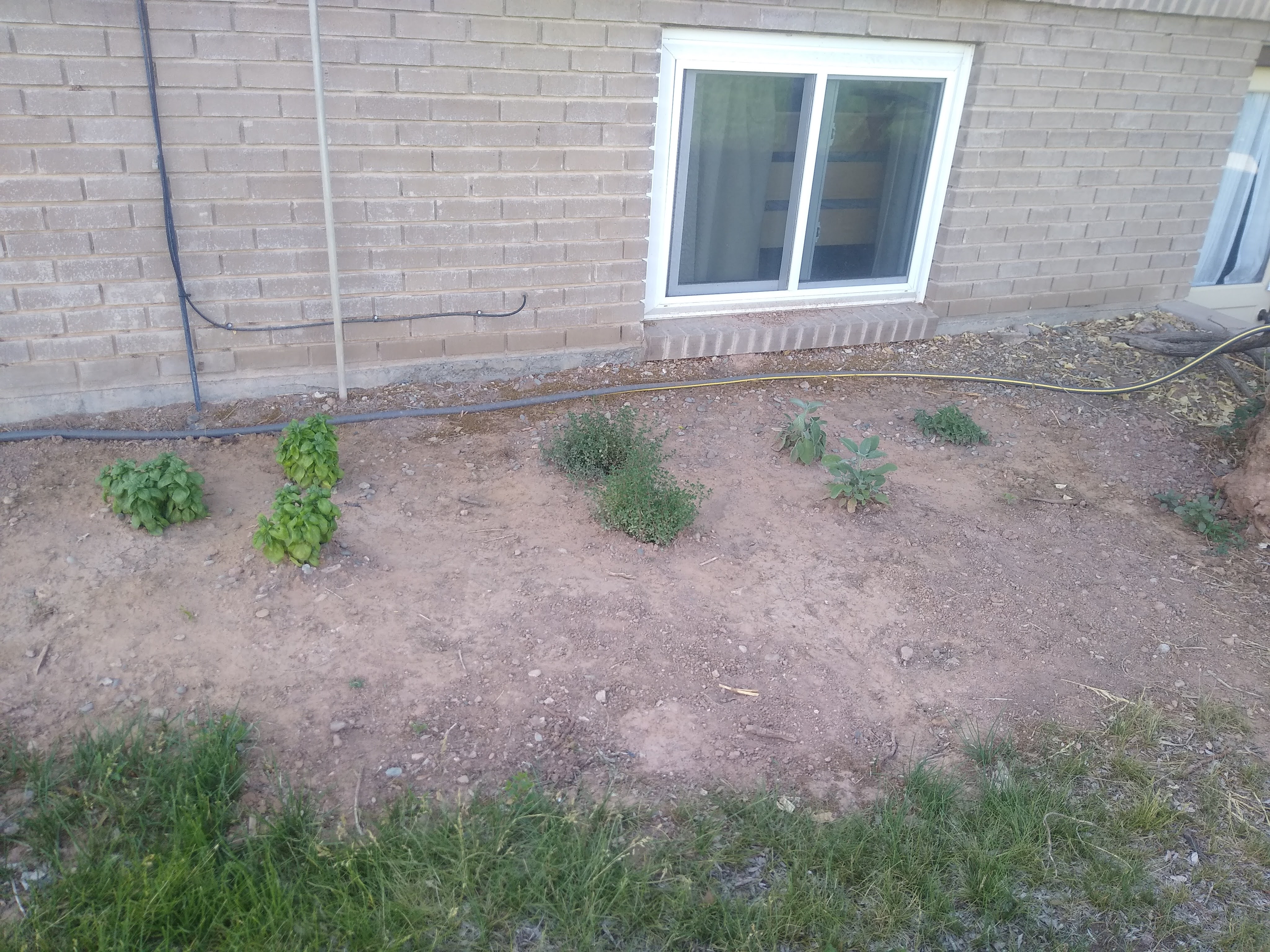
Here’s the beginning of the herb garden, nothing really fancy, but protected from the afternoon sun!

Rose Garden! The first rose bush is a new one. Last year I moved all my rose bushes (about 6 total, I think) and only three survived…but they are happy and blooming!
And here’s our little daisy patch near our driveway. Last year, there were only TWO daisies…but this year! Such a bursting forth of flowers! Also, they need very little water, so they’re perfect for our mountain/desert atmosphere.

2. Project “Delete-The-Juniper-Tumors” is underway; here are some images from that endeavor:

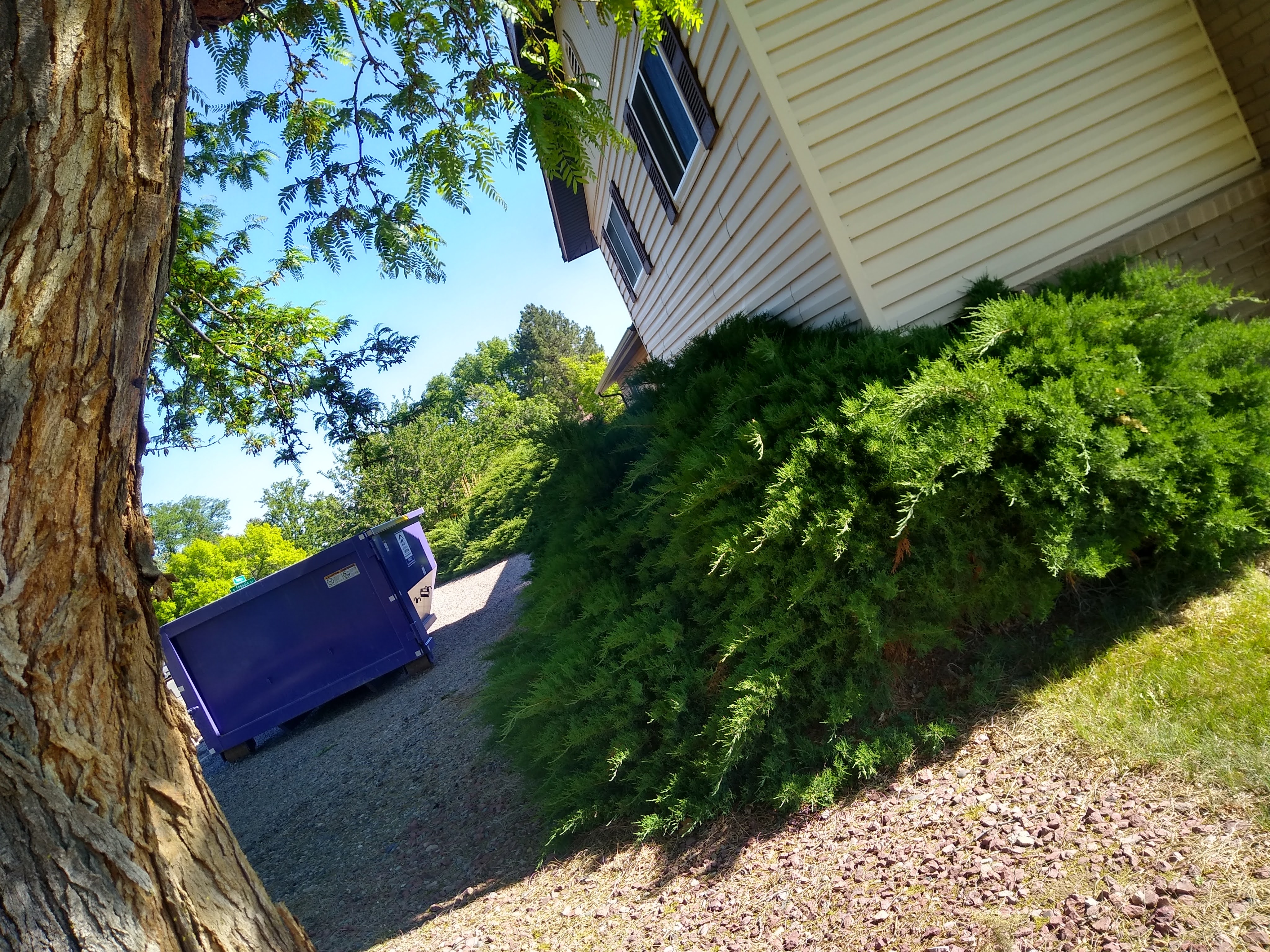
Here they are BEFORE the they shook hands with a chainsaw…

Here’s after. This image is from today; we had to do a lot of clean up of branches and needles. This afternoon, I was able to jump in and get at some of those root-balls. My first victim was the one farthest in this row.

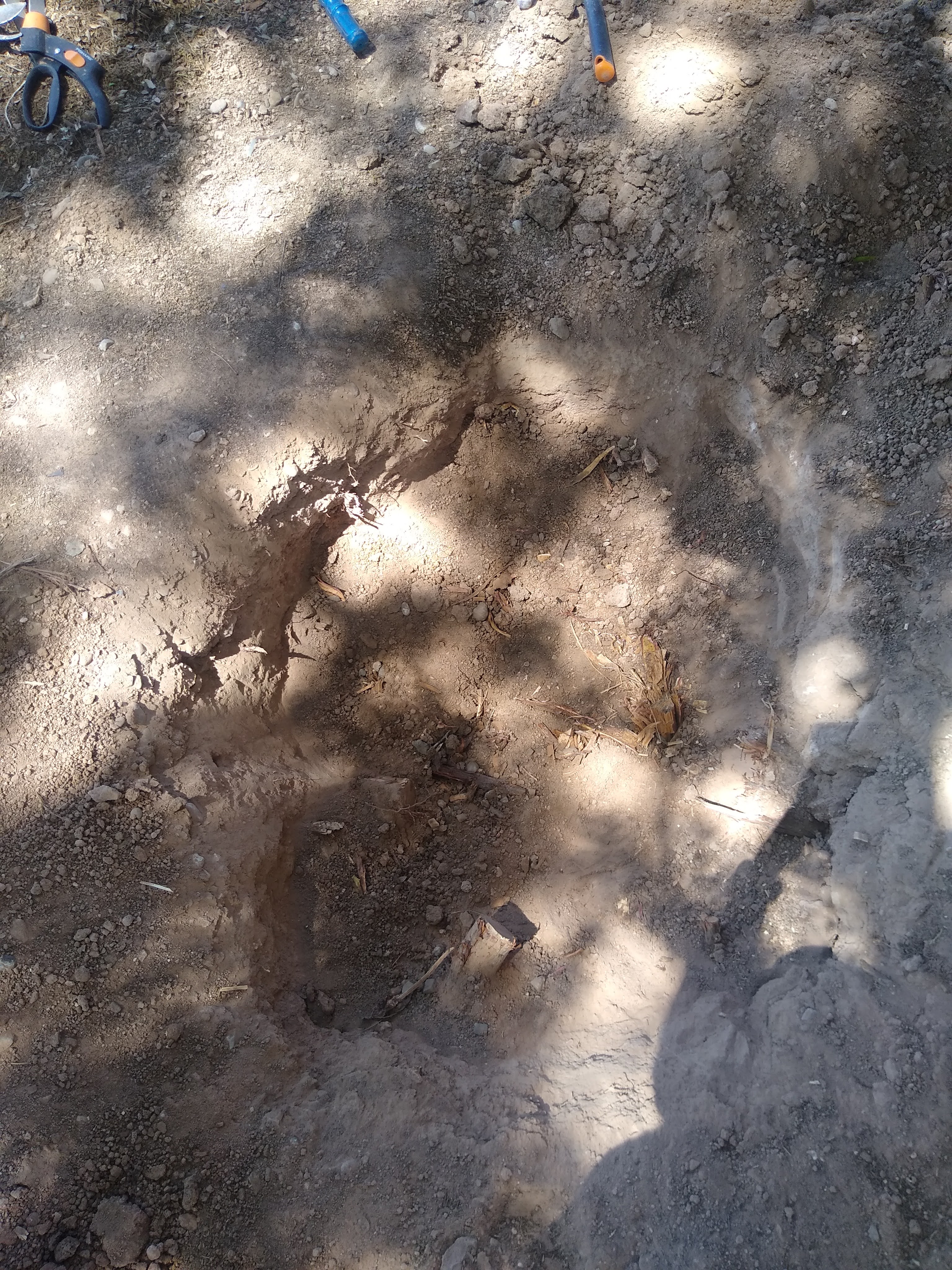
victory! It took about 2.5 hours to get it out. A lot less time invested than I originally hypothesized.

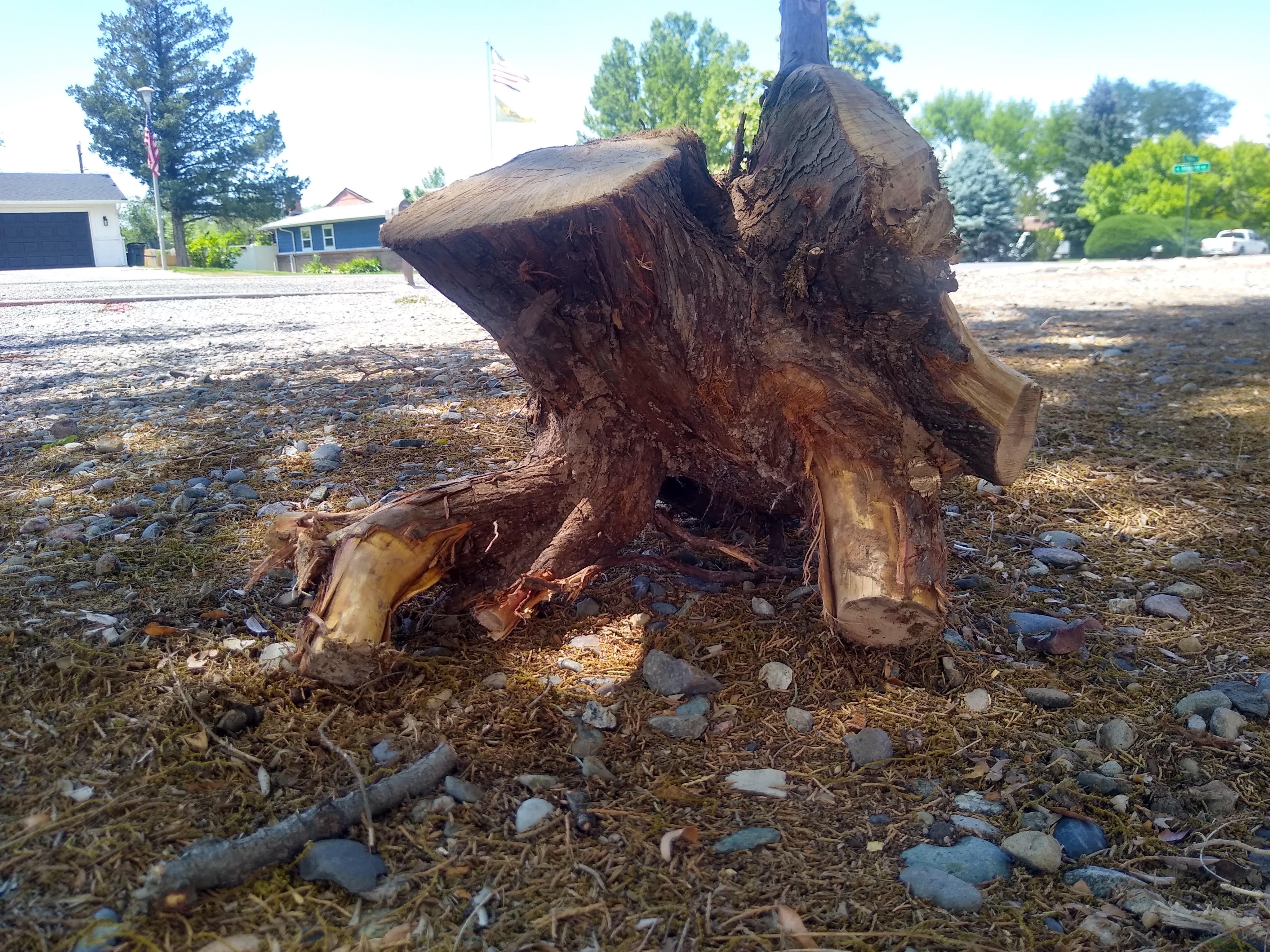
The root-ball in all of it’s exposed glory. Quite light in weight compared to other root-balls I’ve pulled out.
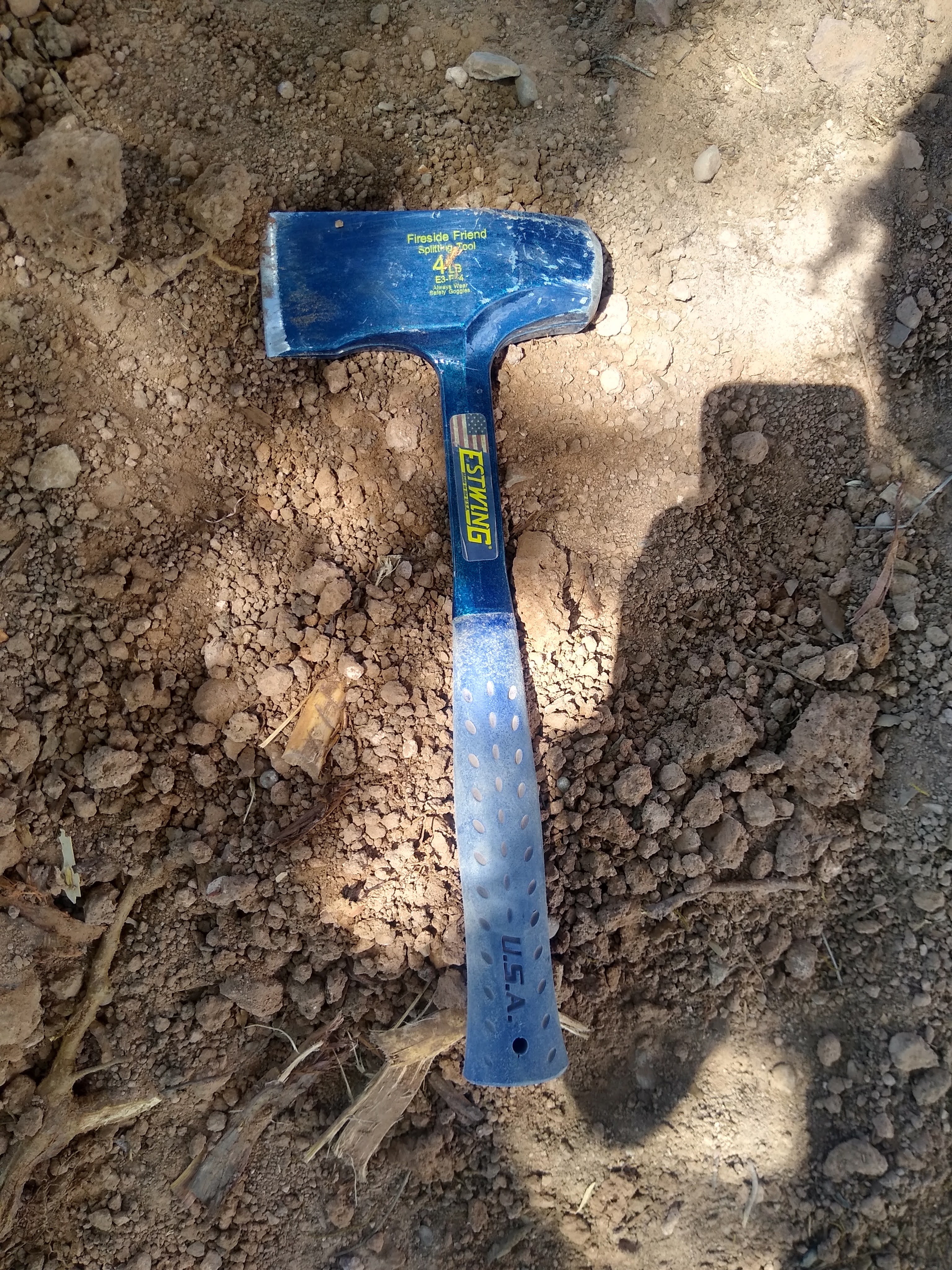
This is my new favorite tool. The roots of these juniper bushes seem to stay really close to the source, so using a bow saw isn’t always easy. But this little axe…it did the trick. And I felt kinda like a badass using it. 💪

3. This morning The younger of #TheBrothersLarkin, #TheFury, and I went to the “Enough is Enough” March for Our Lives protest and march to end gun violence. It was encouraging to see such a great turnout. It was discouraging that it wasn’t bigger.

I appreciated the speakers. It takes a certain amount of strength to get up and sound your voice out against such horrific violence, especially since this issue touches on amendment rights. (I won’t go into that here, that’s another post, of the academic kind, though, fwiw, how does one pursue the rights of life and liberty and happiness if it’s potentially threatened at every turn by an amendment right?) The thing I really want to mention is that many of the speakers made an appeal to “common sense”. Okay, great, thanks Thomas Paine. However, “common sense” is just sense that is commonly held. It’s not guaranteed to be “right” or “good”… It’s the sense of the dominant culture or group; in other words, it’s just common. It’s common sense for me to wear pants when I need to in 2022, but at one point that was the furthest thing from common sense. Common sense shifts and changes and doesn’t have a moral quality about it (thinking of moral virtues) apart from fitting in with the dominant culture or group. And, to be honest and quite blunt, I kind of think “common sense” is what has gotten us here in the first place because we have ceased to have enlightened sense motivated by narratives that exist outside of the ones peddled to us by the dominant culture and group. I think it’s time to be very honest about how infected our common sense is by narcissistic systems and the ideologies and mythologies of whiteness, heteronormativity, and androcentricity (note: I didn’t say anthropocentricity). This is why I appreciate regular encounters with my sacred scriptures and the principal character in my tradition: Jesus of Nazareth the Christ. Regularly telling and explaining his story that is (for Christianity) God’s story in the world for the oppressed and disenfranchised–the story of divine pathos for the entire cosmos–reminds me that there is a need for me to come to the end of my narratives, mythologies, and stories that I’ve spun from within the systems I’ve been raised and die to them. And then in receiving new life in divine love and being (re)located in God I take on new ones that then elevate my view of the world, of my neighbor and of myself. If I just rely on “common sense” I’m most to be pitied and will most likely lead a life that merely perpetuates the violence we are seeing now. I’d like some more appeals to “uncommon sense”.

I was nervous to participate not because I waver on this issue (I don’t) but because I don’t often feel safe in my community. As someone who does not ascribe to views of the majority, I’m aware that I (and my family and friends) could be targets of anger. This protest had emotion attached to it, but it directed toward change and action; not hatred and destruction. Nonetheless, there’s always that one … what if… It didn’t help when a man showed up who was displaying is gun on his hip and then proceeded to record everything from beginning to end. Even when he was asked to stop. The police were of no help because he wasn’t really doing anything illegal (let’s make a distinction between “wrong” and “illegal”). But still, why do that…why film children even when you’ve been asked to stop. My friend and I put our bodies in the way as much as possible to block the children. The entire thing felt like a weird af flex; this is why I don’t feel safe here :/

Okay that’s it…see you next week, beloveds. I’m super glad you’re here and thanks for stopping by.